

How To Get The Ip Address Of A Container Service Aws
Wondering what'due south the IP address of your running docker container? You can audit the running container to get that information.
sudo docker container inspect container_name_or_ID Don't know the container'due south proper name or ID? Use the control sudo docker ps.
The inspect control gives you lot many details nearly the container y'all are inspecting. Become towards the cease and look into the Networks section to get the container's IP address.
Y'all may also use grep control to get just the lines matching the string "IPAddress".
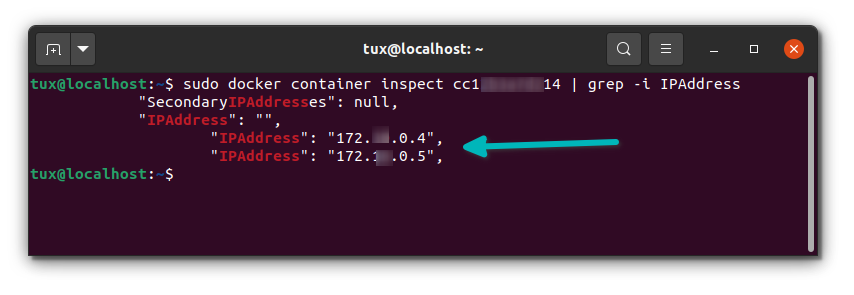
Don't be alarmed if your container has more than one IP address. That's not unusual. To understand that, you need to understand how containers communicate with each other.
I'll explicate that to you in the next section followed by some other methods of getting the IP address of a running docker container.
How docker containers communicate?
Docker is a tool for packaging and delivering software to the masses using containerization technology. Software tin accept a multitude of purposes, from possibly simple text processing to a total web server, hosting your private files. Each of these softwares is broken downward into microservices and and then packaged every bit containers. Depending on the purpose of the software, one service may need to communicate with another.
For example, consider WordPress. There are ii services, one is the web server that serves the frontend, and another is the backend, the database. The frontend has to communicate with the database, otherwise, it just won't piece of work.
This communication is achieved past having at to the lowest degree 2 network interfaces associated with each of these two containers, both interfaces being continued to the aforementioned network. This network is chosen a "docker network".
Docker network
Think of docker network as a puddle of available IP addresses. If two containers take on IP addresses from the same puddle, they're going to exist able to communicate with each other.
There are mainly 2 types of networks, the default or predefined networks and the user-defined networks.
You tin can get the listing of networks using the following command
docker network ls Consider my list below:
❯ docker network ls NETWORK ID NAME Driver Telescopic 272ff2e44dc2 bridge span local 5e4a3f5e99dd host host local cdaef1e49ddc none null local Ignore the last two and focus on the starting time network. The bridge network is the default network every container is going to be connected to if none is specified explicitly. You can become more details about this network by running the docker network inspect bridge command.
I'm going to filter the output since for this demonstration I don't need all the data that inspect is going to explode out.
❯ docker network inspect -f '{{json .IPAM.Config}}' bridge | jq -r .[].Subnet 172.17.0.0/16 If y'all don't have jq installed, please install information technology using your distribution's package manager.
Each of these docker networks has a subnet, in the case of the bridge network, this subnet is 172.17.0.0/xvi. This means in that location are a total of 65,534 - 1 = 65,533 usable hosts or IP addresses. I deducted one since 172.17.0.one is allocated for the gateway. You can see that besides using the post-obit command
docker network inspect -f '{{json .IPAM.Config}}' span | jq -r .[].Gateway Checking your docker container's IP address
There are a couple of ways you tin check the IP accost[es] associated with your container, here is a listing of all of them including command examples.
Method i: By inspecting the container
The audit sub-commands of docker are extremely helpful. A container can exist inspected using the docker container audit [CONTAINER ID]|[CONTAINER Name] command.
Inspecting a container means getting as much data as possible near the container, from ports, environment variables to mount points, cgroup information, etc. IP address can be extracted from it.
If yous run the audit command on a container, y'all'll get a bunch of information, in JSON format. Roll down until you observe the fundamental NetworkSettings, there look for the sub-cardinal IPAddress. That's your container'southward IP address.
The command to execute looks similar the following
docker container audit [CONTAINER ID]|[CONTAINER NAME] Here's my output (truncated)
> docker container inspect ubuntu-ip . . . "NetworkSettings": { . . . "IPAddress": "172.17.0.2", . . . Instead of scrolling through all that, you can filter the output similar this:
docker container inspect -f '{{ .NetworkSettings.IPAddress }}' CONTAINER_ID_OR_NAME Hither'due south a filtered output:
❯ docker container inspect -f '{{ .NetworkSettings.IPAddress }}' ubuntu-ip 172.17.0.2 If you want to get an IP address associated with a specific network, employ a command similar the following
docker container inspect -f '{{ .NetworkSettings.Networks.[NETWORK Proper name].IPAddress }}' CONTAINER_ID_OR_NAME A sample output:
❯ docker container inspect -f '{{ .NetworkSettings.Networks.span.IPAddress }}' ubuntu-ip 172.17.0.2 method 2: Using the container'due south beat out
This is the nearly straightforward method, but besides something I don't recommend .
In this method, you attach your stdin|stdout with the container'due south and run the ip control (or some other command that shows the IP addresses associated with the NICs).
The reason I don't recommend this is that many images are quite lightweight, and don't contain the ip command (or something like).
Take the ubuntu:20.04 image as an example, start a container like the following
docker run --rm --name ubuntu-ip -d ubuntu:20.04 sleep 1d To go on the container running I used the slumber 1d control.
Now get-go a crush process inside the container and attach your stdin|stdout similar and then
docker exec -ti ubuntu-ip sh Once yous're in this container, try running ip or ifconfig. You'll run across something like the post-obit:
❯ docker exec -ti ubuntu-ip sh # ip sh: 1: ip: non found # ifconfig sh: 2: ifconfig: not constitute To get those commands to work, you need to install the relevant packages. To get ip control, install the iproute2 parcel and rerun the command equally ip a
# apt update -qq 6 packages can be upgraded. Run 'apt listing --upgradable' to encounter them. # apt install iproute2 -yqq # ip a i: lo: <LOOPBACK,UP,LOWER_UP> mtu 65536 qdisc noqueue state UNKNOWN group default qlen 1000 link/loopback 00:00:00:00:00:00 brd 00:00:00:00:00:00 inet 127.0.0.ane/8 scope host lo valid_lft forever preferred_lft forever iv: [email protected]: <Broadcast,MULTICAST,UP,LOWER_UP> mtu 1500 qdisc noqueue state UP grouping default link/ether 02:42:air-conditioning:11:00:02 brd ff:ff:ff:ff:ff:ff link-netnsid 0 inet 172.17.0.2/16 brd 172.17.255.255 scope global eth0 valid_lft forever preferred_lft forever Now you lot can see the IP address associated with the bill of fare [e-mail protected] being 172.17.0.2.
Notice the network this container is function of. Since I did not create and connect a user-defined network to this container, information technology was connected to the bridge network, which is why the network of this IP is 172.17.0.0
This method surely works, although it'due south more than work and not very reproducible, it'south intuitive. The next methods should exist much ameliorate compared to this one.
Method 3: By inspecting the network itself
Whenever a container gets connected to a network, that connected container is visible from the network also, forth with the IP address allocated to those containers.
Since my container is connected to the bridge network, I can inspect the network with the following command
docker network inspect [NETWORK NAME][NETWORK ID] Hither instead of an id, I'll use the proper name, span
docker network inspect span Instead of scrolling downwardly to the Containers department, I'll use jq to filter the output this time.
❯ docker network inspect bridge | jq .[].Containers { "1c76f35ce42ca0d31cfcc79da80eadfa4f69cb82e292e249ee1bd75d83a8e4ba": { "Name": "ubuntu-ip", "EndpointID": "44d6b85348d6274b4ee779f9d3617d184ccfd3bad228ee652141d9b4157c50ae", "MacAddress": "02:42:ac:11:00:02", "IPv4Address": "172.17.0.2/sixteen", "IPv6Address": "" }, "50a4f195d8eae6b6b714e8aa058c6058dbe91d0a272c8ca826d4442df1c63885": { "Proper noun": "ip", "EndpointID": "d4e72a4df81ee7023386df9d96676d9c291e2902349eb453338b8e0145a610fd", "MacAddress": "02:42:air-conditioning:11:00:03", "IPv4Address": "172.17.0.iii/16", "IPv6Address": "" } } To demonstrate this, I deployed another container with the name ip. You can see the containers and IP addresses in the to a higher place JSON object. Now extracting the IP of a specific container is slightly harder here.
If you lot know the container id, you can employ jq like this
docker network inspect span | jq '.[].Containers."[CONTAINER ID]".IPv4Address' Hither's an example
❯ docker network inspect bridge | jq '.[].Containers."1c76f35ce42ca0d31cfcc79da80eadfa4f69cb82e292e249ee1bd75d83a8e4ba".IPv4Address' -r 172.17.0.2/xvi Near of the time you can not call up the container id, then if you lot want to get the IP from only the container name, you lot need some knowledge of jq (or merely reuse the following command).
docker network inspect -f '{{json .Containers}}' span | \ jq '..|if blazon == "object" and has("Name") then select(.Name=="[CONTAINER Proper name]") | .IPv4Address else empty end' -r Identify the container name in the select function and see the magic happen.
❯ docker network inspect -f '{{json .Containers}}' bridge | \ jq '..|if blazon == "object" and has("Proper noun") and then select(.Name=="ubuntu-ip") | .IPv4Address else empty end' -r 172.17.0.2/16 Which method do yous prefer? Method i probably
Those were all the methods through which y'all tin can get the IP accost[es] of docker containers. The second method although intuitive isn't reproducible. Almost of the time it's the outset method that gets used since it's the easiest and gets the task done.
But there may come a time when you'd desire to check what some containers are connected to a certain network and get the IP addresses on that network. In that instance, inspecting the network and getting the IPs makes sense. Y'all can get all the container names and IPs allocated to them from a network like this
❯ docker network inspect -f '{{json .Containers}}' bridge | \ jq '.. | if blazon=="object" and has("Proper noun") then {(.Proper noun): .IPv4Address} else empty end' { "ubuntu-ip": "172.17.0.2/16" } { "ip": "172.17.0.iii/sixteen" } Alter bridge to some other network, and you lot'll become all the containers and their IP addresses like this.
That's it for today. I hope this article was helpful to y'all. If you have any questions, exercise permit me know in the comments downwardly below.

How To Get The Ip Address Of A Container Service Aws,
Source: https://linuxhandbook.com/get-container-ip/
Posted by: saundersawareed40.blogspot.com
0 Response to "How To Get The Ip Address Of A Container Service Aws"
Post a Comment